Confessions of a discontinued perfume addict.
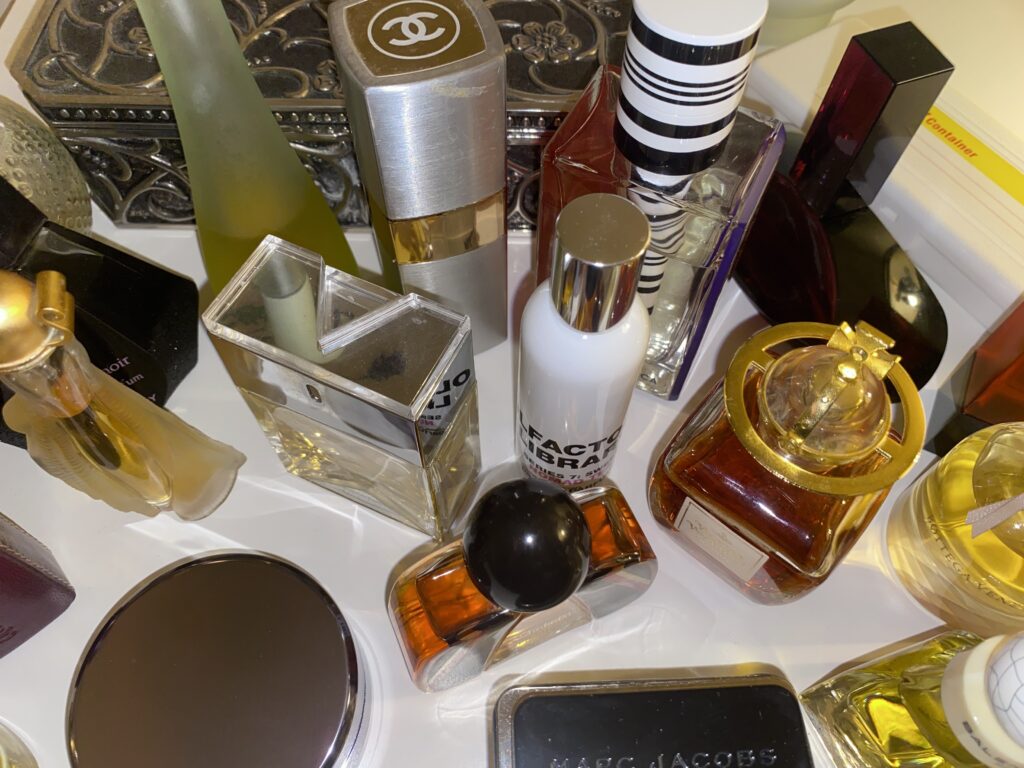
In 2026, it is nearly impossible to identify as a perfume enjoyer without being hyperaware of the conditions shaping the fragrance landscape. The air is thick, the shelves are crowded, and it’s obvious that the industry has leaned hard into a strategy of aggressive, almost dizzying proliferation. Every visit to Sephora or Ulta reveals another crop of hot, new, limited-edition flankers, many of which are destined to travel to Nordstrom Racks or TJ Maxxes before quietly disappearing. Entire brands seemingly materialize overnight, self-sorting into categories like niche, artisanal, indie, clean, conscious, and/or disruptive. And on social media, the spectacle intensifies: influencers peddle fragrance PR (often not disclosed) against backdrops of Ikea shelves groaning under the weight of 500+ bottles. It appears that the romantic quest for a signature scent has succumbed to a new aspiration: ownership of a collection that is robust, curated, and ever-expanding.
I am hardly the first to notice this sensation. Other writers and cultural critics have already expounded upon this shift, like Cut writer Cat Zhang and fellow Chicagoan fumehead and friend Audrey Robinovitz. Fragrance is more popular than ever–this is indisputable. It seems brands are scrambling to release, influencers are scrambling to review, and consumers are devotedly smashing ‘buy.’ I can hardly keep up with the pace. In fact, I’ve stopped trying.
There was a time when I was a willing participant. I ordered decants monthly, then weekly from sites like Luckyscent or Surrender to Chance. I spritzed testers at big-box beauty retailers, stalked department store perfume counters, and left each shop with a lighter wallet. All it took was a glowing influencer review or a friend’s earnest recommendation for me to pull the trigger. Over time, this impulse soured into something more frenzied, more impatient. I recognized that my purchases were no longer guided by taste or desire, but rather by a fear of missing out. The perfume industry has become eerily adept at cultivating this sensation, keeping me in a near-constant state of temptation. I never thought of myself as a “Is this TV show my friend?” ass bitch, but there I was–with 50 plus bottles and over 300 samples–still trapped in the never-ending hunt for The Best Most Perfect Perfume of All Time Ever. I’ve since weaned myself off that cycle. My compulsive sampling habit has slowed considerably, and I very rarely buy new bottles. However, my impulse to procure perfume has not disappeared. It’s simply reoriented itself towards a more narrow, intentional fixation: buying discontinued fragrances.
I’d like to preface by emphasizing that the buying part of this process is actually the least thrilling part. The real intoxication lies within the research, the hunt, the waiting. An early instance of this occurred with the perfume Nu (2001) by Yves Saint Laurent, created by illustrious perfumer Jacques Cavallier under the creative direction of the one and only Tom Ford. I was in the beginning stages of my fragrance enthusiast journey (only six bottles and twenty samples) when I underwent the rite of passage that I assume every aspiring fumehead is destined to go through: creating a Fragrantica account. After diligently cataloguing my haves, my hads, and my many, many wants, I fell into forum threads detailing vintage legends and overrated darlings.
Somewhere in those endless message boards, Nu surfaced as a fan favorite, captivating me instantly with its spicy-woody note pyramid (I had yet to smell a perfume with cardamom listed as an accord). The reviews were glowing, too–I distinctly remember reading a specific sentence written by Fragrantica user Assiduosity:“A truly sacred and profane perfume, Nu is probably best summed up by the phrase ‘orgy in the temple.’ With a deft hand it mixes conventions of Eastern and Western worship.” As a cherry on top of the temple orgy, the fragrance’s simplistic, monolithic, space-agey bottle design sealed my fascination. I desperately wanted that chrome hockey puck in my modest, slowly growing collection. But to my dismay, I quickly learned that Nu was gravely discontinued since 2007, when I was in second grade.
Reading the word “discontinued” conjured mental images of products like Crystal Pepsi and the Sega Dreamcast-inventions that once felt futuristic before quickly becoming obsolete. It had never even crossed my mind that fragrances could also just… disappear. I’d always assumed that they stuck around forever–wasn’t Chanel No. 5 older than my grandmother? None of the fragrances in my collection seemed to be under threat of extinction–they were mostly post-2010 releases, all alive and well on Sephora shelves. Even the “older” perfumes I owned were still on the market, like Tommy Girl by Tommy Hilfiger. I sifted through dozens of reviews grieving Nu’s metallic sci-fi bottle and unique scent composition, now lost to the sands of time. Commenters waxed poetic not just about the perfume itself, but about the optimism of the early 2000s, when the future seemed glossy and imminent. It was clear that Nu was not just a product, but a coveted rare artifact. This added statistic of scarcity solidified my resolve, and even though I’d never smelled Nu, I wanted it in my collection. I needed to know what was so special about this sought-after gem.
Thus began the search. I wasn’t even able to find it in stock on any decant sites–so I began bracing myself for the dangerous, sinful act of blind buying a full bottle. But where to find one, when retailers no longer carried Nu? At this point in my collection journey, I was familiar with grey market sites like FragranceNet, but I’d never realized it was possible to buy perfume secondhand.
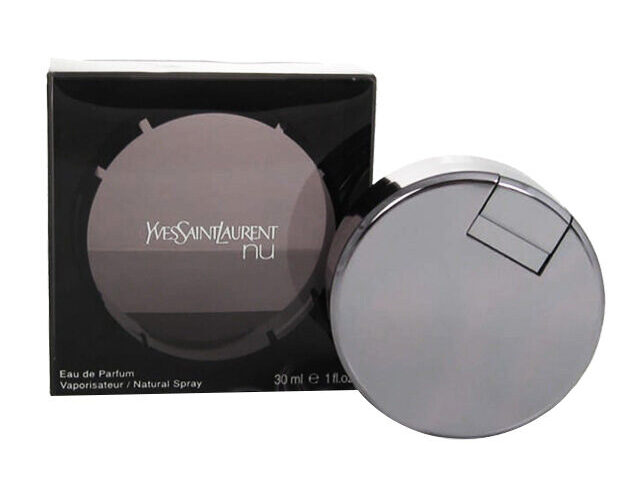
My initial searches on Ebay and Mercari yielded staggering prices–I saw bottles listed for exorbitant amounts like $300, $500, $800, all for a perfume I had never smelled, mind you. As of February of 2026, I can proudly report that I’ve never spent more than $205 on a single perfume, discontinued or otherwise. At the risk of sounding like a cut-fruit diaspora poem, it is undeniable that the propensity to pinch pennies runs deep within my blood, handed down from both my stiffly Protestant German-Texan great-grandmother and my militantly frugal Nanjing-born popo. I’m quite pleased with how I’ve cobbled together a rather enviable fragrance collection without straying too far from the cheapskate ethos I inherited. I like to think my immigrant foremothers would approve–glamour, yes, but never at full price.
I wasn’t going to let any perfume, even the mythological Nu, lure me into abandoning my thrifty instincts. Instead of paying $300 or more, I set up saved search alerts as if setting bear traps in the deep woods. I lurked obsessively in Facebook groups and swap forums. I sent embarrassingly cheap lowball offers, hoping sellers would take pity on me. Then eventually, over the course of several months, I began reconciling with the reality that I would likely never own a full bottle of Nu–unless I was willing to forgo paying rent for a month.
Over two years later, a saved search alert notified me that someone was selling a 30ml bottle of Nu for a mere $40. I frantically scanned the listing, looking for evidence that it was not a scam. I could hardly believe my eyes, the seller was verified. Posted 2 minutes ago. 98% full. With a price this exceptional, it didn’t make sense to just send an offer, I needed to buy it now before someone else snatched it up. I clicked through tabs until I saw the order confirmation page. My heart fluttered. After years of anticipation, would my expectations of the legendary Nu line up with reality? For $40, I was willing to take that chance.
The package arrived a week later. Cocooned in a nest of scrunched tissue paper sat a clear plastic box (yes, it came in the original box!) encapsulating the chrome hockey puck I’d been cyberstalking. I gingerly unsheathed the bottle from its packaging and sprayed it tentatively, watching it dribble weakly onto my wrist. This was expected, as I’d been warned online that the bottle, although beautiful in its simplicity, has a pretty subpar atomizer. I waited for the aroma and braced myself as I held my wrist to my nose.
The spicy temple orgy arrived as promised. A sharp ribbon of black pepper slices through a powdery cloud of warm cinnamon-cardamom, and settles against a base of bittersweet sandalwood–more dry than creamy, which I prefer. Smoke rises from burning incense and intertwines with a flickering citrus brightness, calling to mind one of my favorite vintage fragrances, Yves Saint Laurent Opium. But where Opium reclines on velvet cushions, Nu stands upright. Supported by those dry sandalwood beams, the incense does not billow lazily–it threads precisely through the composition, pointedly making its presence known. The texture is powdery, but not cosmetic; it’s more like incense that has burned down to ash. The sweetness is anything but syrupy, it’s more of a gentle, restrained suggestion. Nu is not exactly warmth, but after-warmth, like embers that have partially cooled. It is not cozy or flirtatious. It is composed, controlled, yet pulsing with an inner heat just below the surface.
A successful blind buy, indeed. Nu had satisfied my expectations and proven itself to be more than worth the $40 I’d spent on it. Today, it is only one of many grails acquired through the same ritualistic process: hunting, lowballing, pouncing. Some of my most satisfying victories have been:
– Vivienne Westwood Boudoir (1998). 75 ml for $100. This is a more recent purchase, acquired shortly before the re-release was announced. Bewitching and sensual, it lingers on skin for hours, curling fingers of spicy carnation and marigold around my neck.
– Marc Jacobs Marc Jacobs (2001). 50ml for $80. My perfect, girlish gardenia; it leans more watery than creamy, more lucid than lush. People compare it to Gucci Bloom, Tocca Florence, and other white floral something-or-anothers, but they’re wrong.
– Chanel No. 19 (1970). 50ml for $36. While not technically discontinued, Chanel No. 19 has been altered enough from its original formulation that I feel justified including it on this list. Cool, austere, sophisticated; I think of it as one of my “grown woman” fragrances.
Lately, I find myself wondering why I developed this proclivity for discontinued fragrances. Many users online pine after these scents because they once owned them in their youth, and are now chasing a feeling of nostalgia. Not me–I discover a discontinued scent from a time when I was either not yet born or not yet sentient, track down a sample if humanly possible, fall in love, and then commence a years-long campaign to obtain it. New releases barely register for me anymore.
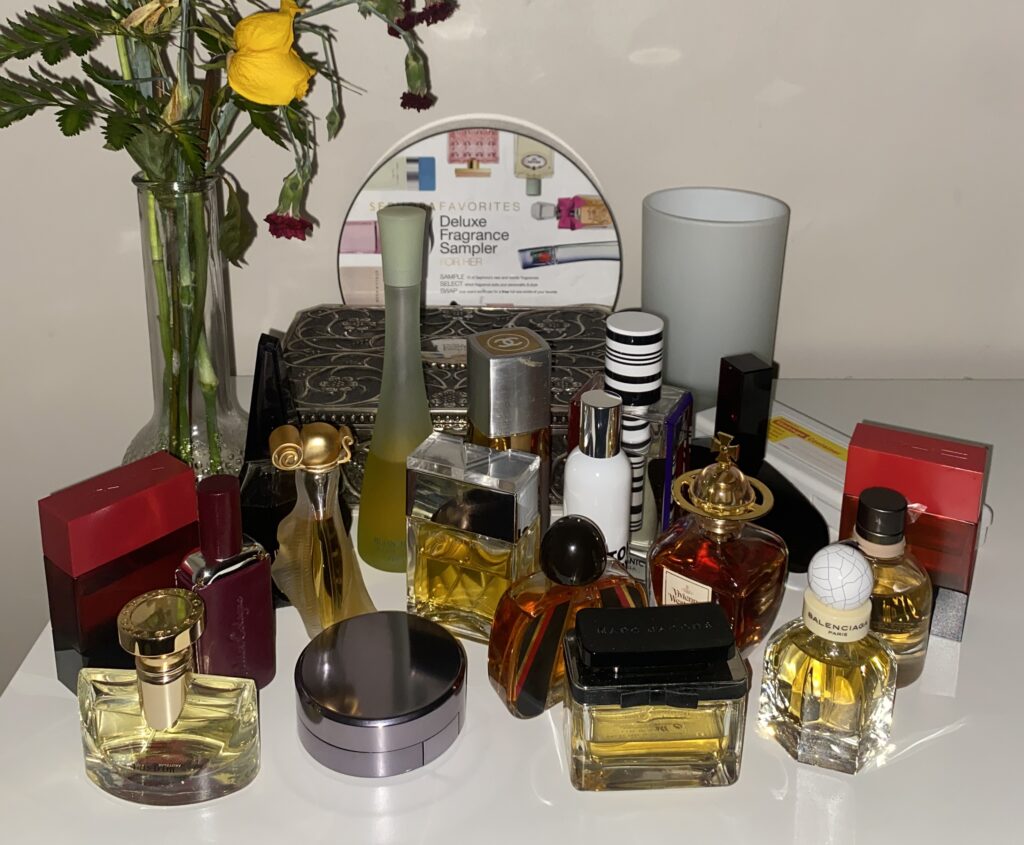
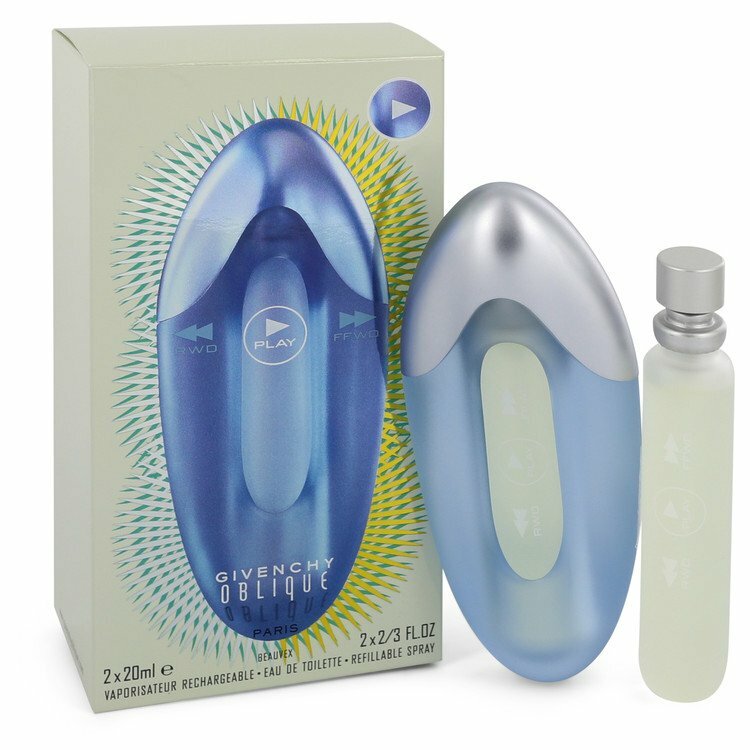
Part of it, certainly, is the thrill of the aforementioned hunt. But I think the real reason is rarity. Discontinued perfumes feel like relics from another era, housed in boxes and bottles bearing long-abandoned brand identities, smelling of molecules since banned or reformulated away. Some preserve their cultural moments perfectly: my Givenchy Oblique sample set is decorated with “rewind” and “fast-forward” buttons, and packaged with a real, playable CD-about as Y2K as it gets. Each bottle is a rare encounter, a fleeting window into a vanished moment in both perfume and pop culture history. They make me nostalgic for a past that I often never actually inhabited, and I appreciate them as fragments of beauty that will never be created again.
Still, nostalgia only explains part of the allure. The rarity itself also casts a kind of spell, one that follows the perfume from shelf to owner. If I obtain that perfume, its aura transfers to me, and having something novel and unique makes me feel novel and unique. I have now evolved into The Woman Who Collects Discontinued Perfumes, like a hyper-specific Facebook t-shirt. I wish I was exaggerating, but it’s gotten to the point that my non-fumehead friends hug me, inhale, and ask, “What is that?” Then, narrowing their eyes slightly, they chide: “Is it something I can buy, or is it discontinued or whatever?” My reputation precedes me.
I don’t particularly mind–in fact, I welcome it. Luckyscent is practically mainstream now, but my discontinued treasures more or less guarantee my status as the most esoteric bitch in the room. Merely having knowledge of these near-extinct bottles grants me intermediate fumehead status, and successfully procuring them elevates me to advanced. As I secure them for under $300, I ascend to S-tier. At least, this distinction exists in the elaborate fantasy leaderboard I privately maintain in my mind.
So yes, I am pretentious. But in all my pretension, I have successfully quieted the noise of the madding perfumetok crowd, and traded it for a process that is more deliberate, more intentional, and more neurotic. It is a slow and occasionally torturous method of consumption, but it’s better for your wallet, and a million times more satisfying. When a perfume has been on my want list forever, I’ve gone through five samples of it, and I’ve had saved searches set up for years–finally, when that magical $50 listing comes my way, that success feels like nothing else in the world.
I do occasionally wonder whether this slower, secondhand approach to collecting perfume might eventually become a trend in its own right. Retail prices continue to climb, and the rise of so-called underconsumption-core suggests that younger buyers are already starting to push back against the cycle of constant newness. Add to that Gen Z’s fondness for romanticizing and core-ifying the past–the recent wave of 2016 nostalgia being only the latest example–and it’s easy to imagine discontinued perfumes finding new admirers. I can already see it: princessy pink perfumes like Miss Dior Cherie or YSL Babydoll would strongly resonate with the coquette girlie crowd, while the breezy simplicity of Marc Jacobs Rain or Gap Grass would slot neatly into the universe of “clean girl” minimalism.
Admittedly, the pretentious part of me secretly hopes that the trend never quite materializes. Call me a gatekeeper, but there’s a quiet satisfaction in caring for fragrances that the wider world has mostly forgotten, in treating each bottle like a small, private relic. My discontinued perfumes feel like beautiful secrets that I’m lucky to be privy to, and I’m not entirely sure I want them to become common knowledge–especially after all the sleuthing it took for me to unearth them.
Perhaps it is in this very act of quiet stewardship that I’ve stumbled upon something rarer than any bottle. Compared to the manic churn of modern fragrance culture, my current method of perfume collecting feels almost monastic. Writing this now, I think the rarest thing I’ve found isn’t perfume at all, but patience: I’ve slipped free from the rip current of FOMO and drifted into calmer waters.