Untangling the meaning-making behind perfume for infants, and facing the fraught reality that our various performances of empathy are more grown-up than ever.
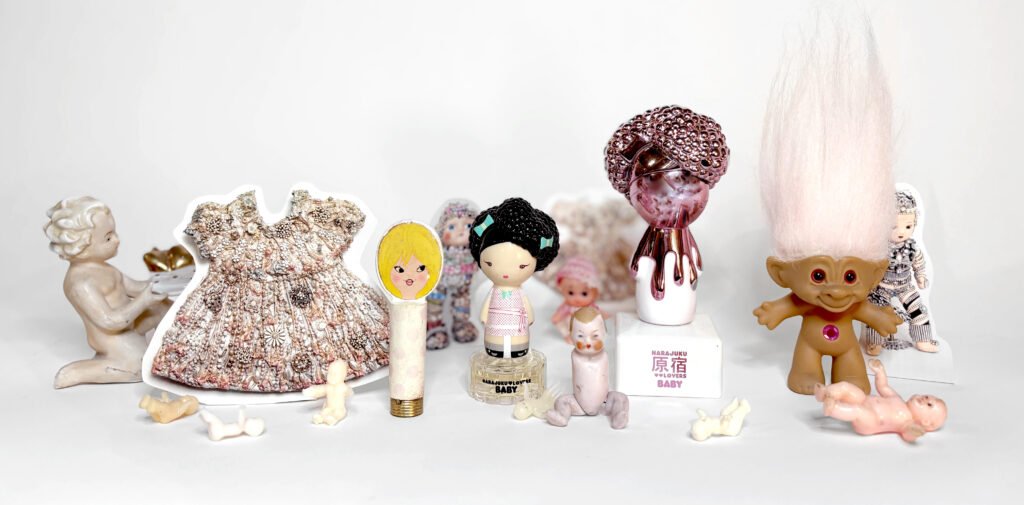
Okay, for starters—
That’s really the point, isn’t it? The start. Shape it with whatever phrasing you wish: we’re born, and then we die. None of us asked to be here. There’s maybe no stable correlation between age, maturity, and wisdom—as much as we might want something that reliable with which to map our lifespans.
And that’s really the point, isn’t it? We want. Our earliest impressions are formed between the need of hunger and the quality of care with which it is met. You ever see a colt or giraffe minutes after birth? How they stagger into a stride that they’ll keep up for a lifetime.
So to begin, I must disambiguate that this bit of writing has ostensibly nothing to do with infants, except that any of us engaging with it and the fragrances to which it’s oriented were infants sometime before now. Instead, I am interested in tracing the logics, meanings, and styles of ‘baby.’ This is a softly rendered forensics combing through tender effluvia, gathering filaments that connect Emma ‘Baby Spice’ Bunton, the someone addressed by Britney Spears demanding ‘Baby, one more time,’ Edgar Wright’s 2017 action film Baby Driver, and Bette Davis’ ‘Whatever Happened to Baby Jane?‘ and other examples of states of mind and ways of living in which ‘baby’ is with us for life. At its most ubiquitous, this is an aesthetic impulse registered at every invocation of ‘baby’ as love interest in decades of pop, R&B, even Christmas standards; its fullest extension may be surveyed in the ‘adult baby’ forums on FetLife or traced across the trajectories of someone like Stefonkee Wolschtt, a 46-year-old transgender woman who in 2015 reportedly announced she was being ‘adopted’ by two parents to live as their six-year-old daughter.
While it could also be said that what is presumed about the pre-verbal experience of infancy is its own kind of fantastical projection, the enterprise of perfumes marketed ‘for’ and with notions of ‘baby’ can be measured with a Lacan-inflected attention to the ways fantasy articulates desire toward the production of a self image. What we—as individuals or a complex, aestheticized cultural economy—believe we may have wanted at those earliest ages are as much if not more operative in the construction of the us that wonders about it than any forensic recovery of the drives of our own infancies.
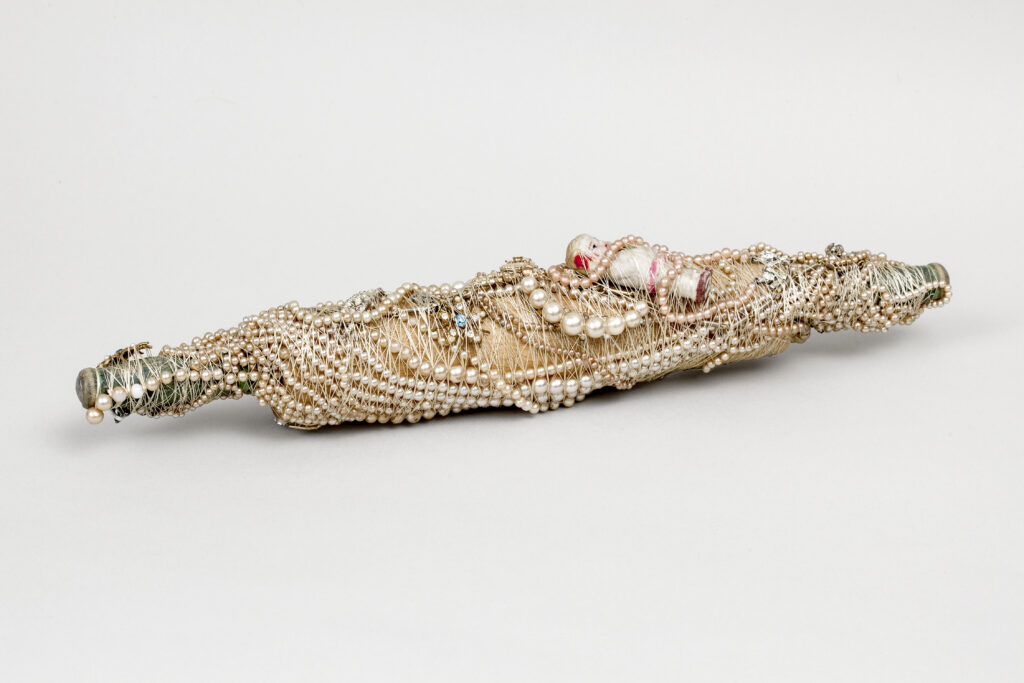
Nancy Youdelman. Rolling Pin with Pearls & Tiny Porcelain Doll, 2016
mixed media
3 x 15.5 x 3 inches
photograph by Michael Karibian
© 2026 Nancy Youdelman
Courtesy of ADZ Gallery, Lisbon, Portugal
What scents mark the threshold at which lovers or spouses call each other ‘baby’? I have two grey boy cats, one who we always address as ‘buddy,’ and the other everyone calls ‘the baby’—it’s the differences, what makes one baby and the other not that interests me. The Waves is ‘baby,’ while his brother Orlando is ‘buddy’ or even ‘little fellow’—the irony here is that in Orlando’s own rush to grow up too fast, he’s probably the more emotionally fragile of the two; baby The Waves has excellent ego–id health, living mostly as his heart dictates. This thinking hangs around the edges of the emotional resignation of having to ‘baby’ ‘him,’ him being anyone of such high maintenance and neediness for careful validation that they need a big nap. This is the [sugar] baby posing opposite to the spectral sugar daddy. So while we are, in part, entangling this investigation with some products released as fragrances to be sprayed onto infants, even in those instances the slippage of those products onto a formation of adulthood is of greater interest than their prescribed uses. These perfumes comprise a productive medium through which to consider what is done beyond intent, design, and marketing; ballistic dispersals of molecules that slide up nostrils or catch a breeze to be carried elsewhere lend a physical form to the ways ideas tend to exceed the bounds imposed on them. I want to think about what such perfumes do when they’re worn by you or me.
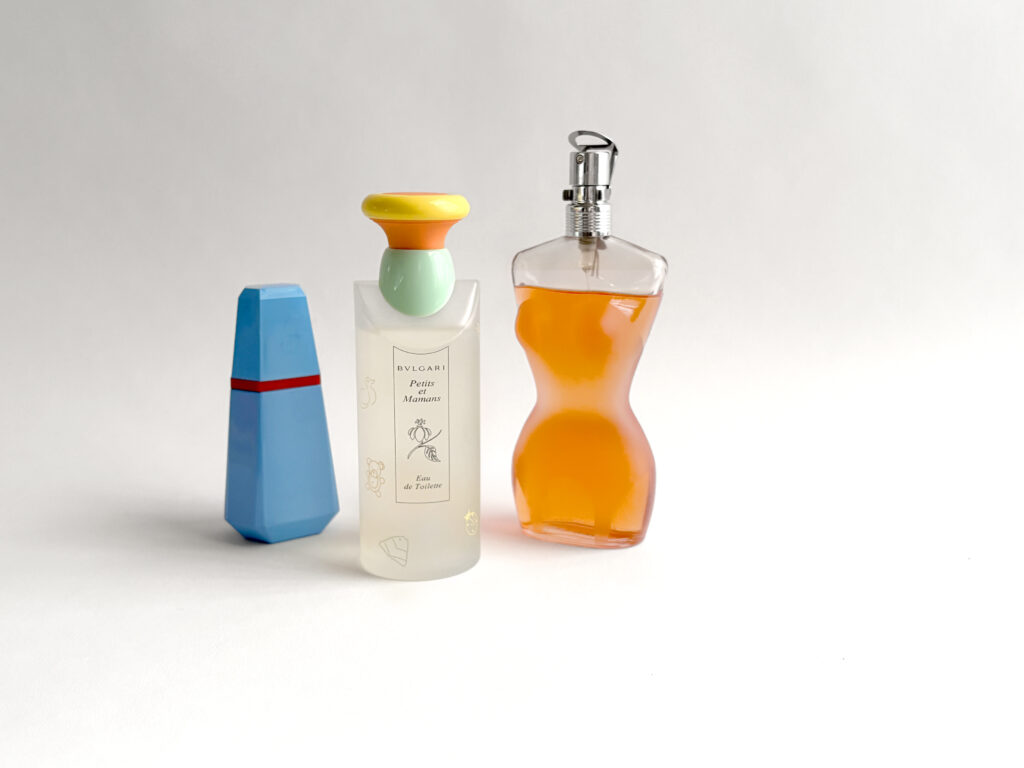
‘Nativity scene’ comprising LouLou, Cacharel, 1987; Petits et Mamans, Bvlgari, 1997; Classique, Jean Paul Gaultier, 1993, from the author’s personal collection, 2020, photographed 2026. Courtesy of studio of Matt Morris.
About a decade ago while researching for an art project I was developing, I sourced a bottle of Bvlgari’s Petits et Mamans, released 1997, formulated by Nathalie Lorson. At the time, I had planned on incorporating its soft, powdery scent into a gallery installation—and sure enough, I think it’s been involved in three different projects of mine over the years. But the unexpected additional consequence was that I really loved the scent, the filtered sunshine it brings to life on my skin, tinged with tea, flowers, and powder. There are probably some cultural conventions reinforced with market research that explains why underripe peach, chamomile, iris, and softly expressed vanilla were the notes assigned to a perfume for babies. Before ever smelling it, I’d read that some people feel Petits et Mamans smells like the freshly washed head of a newborn. I don’t find that to be the case whatsoever; rather, the water-based fragrance possesses an unexpected sophistication, drowsily spiced, dreamy but still neat in its structure. It’s a uniquely circumspect perfume when I’m wearing it—quietly contemplative, reserved but elegantly incorporating floral, fruity, herbaceous, wood, and citrus into a clean powdery reverie, light as first snowfall.
This perfume-for-babies product followed on a phenomenon more or less institutionalized in the market when Dior rolled out a line called Baby Dior in 1970, which was eventually abandoned and then revived in 2023 by Francis Kurkdjian after his arrival as the brand’s Perfume Creative Director, and Cordélia de Castellane, who was appointed to Artistic Director of Baby Dior. Since this starting place, perfumes marketed for use with babies have emerged at every tier of pricing—nearly always water rather than alcohol based, nearly always competing for the lightest scent profile.
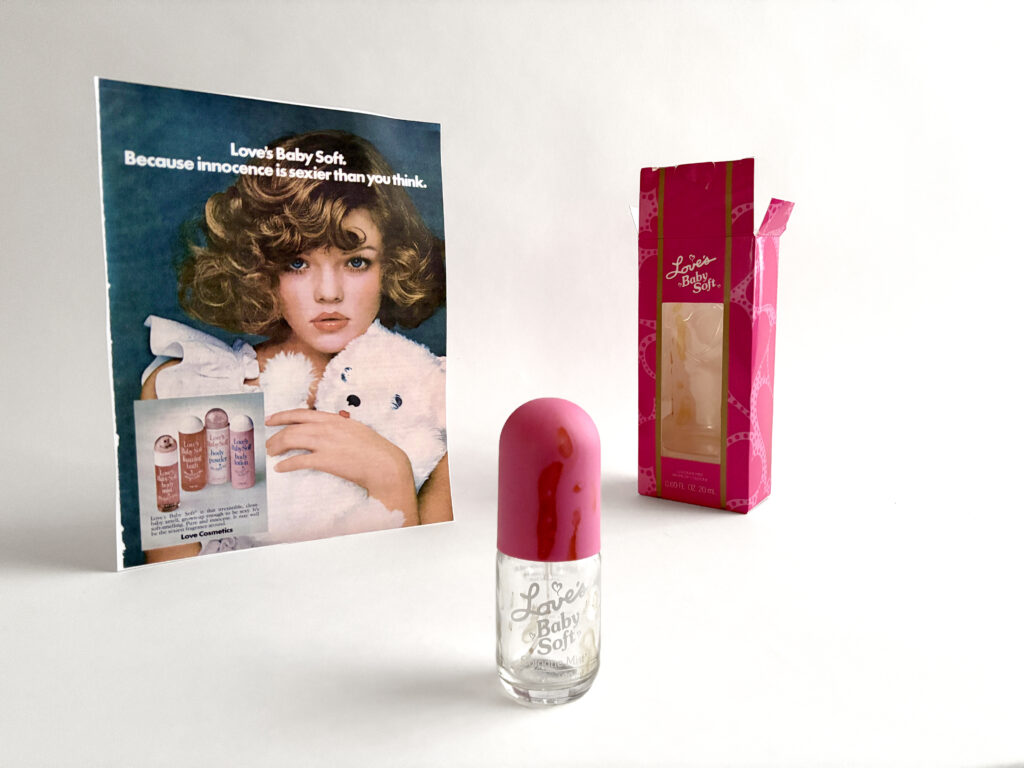
Photograph of personal collection by the author, 2026. Courtesy of studio of Matt Morris.
Even with this nascent market sector, almost immediately another way of comprehending ‘baby’ enters public consciousness with the runaway popularity of Love’s Baby Soft by Dana, which premiered in 1974 and has gone on to define adolescent entrance into young adulthood for several generations. Baby Soft was, in knowingly crossing signals, promoting innocence as a means of attraction, a Lolita style of sexuality that as a rhetorical strategy runs headlong into taboos too easily associated with underage Epstein sex trafficking. But leaving behind the suggestiveness of its earlier marketing campaigns, the fragrance itself is a venerable point of reference for a powderiness indebted to yet distinct from decades-old vintage interpretations. The super-powered powder heart of Baby Soft is clean and bathroomy, cosmetic, seductive—reviving a profile that resembles Helena Rubinstein’s 1941 Heaven Sent. Dreamy to the point of delirium, sweet enough to become sharp, these are the historical tropes of hyperfemininity reclining on clouds with pastel butterfly wings and harps and ecstasy.
I have so many friends who melt into reminiscence around Love’s Baby Soft being the magic elixir that transitioned them out of girlhood. It was a core element of beauty rituals practiced as an art—glamorous, flirtatious, self possessed. To apply Baby Soft was both to identify as growing into a woman and also wanting to be Baby, at least someone’s baby. I’d read about Lolita Lempicka’s Mon Petit for a few years, but had no firsthand experience with the fragrance before I got an alert on my phone last year for a full tester bottle available for sale online. It lacked exterior packaging or a cap, but was all the more affordable as a consequence.
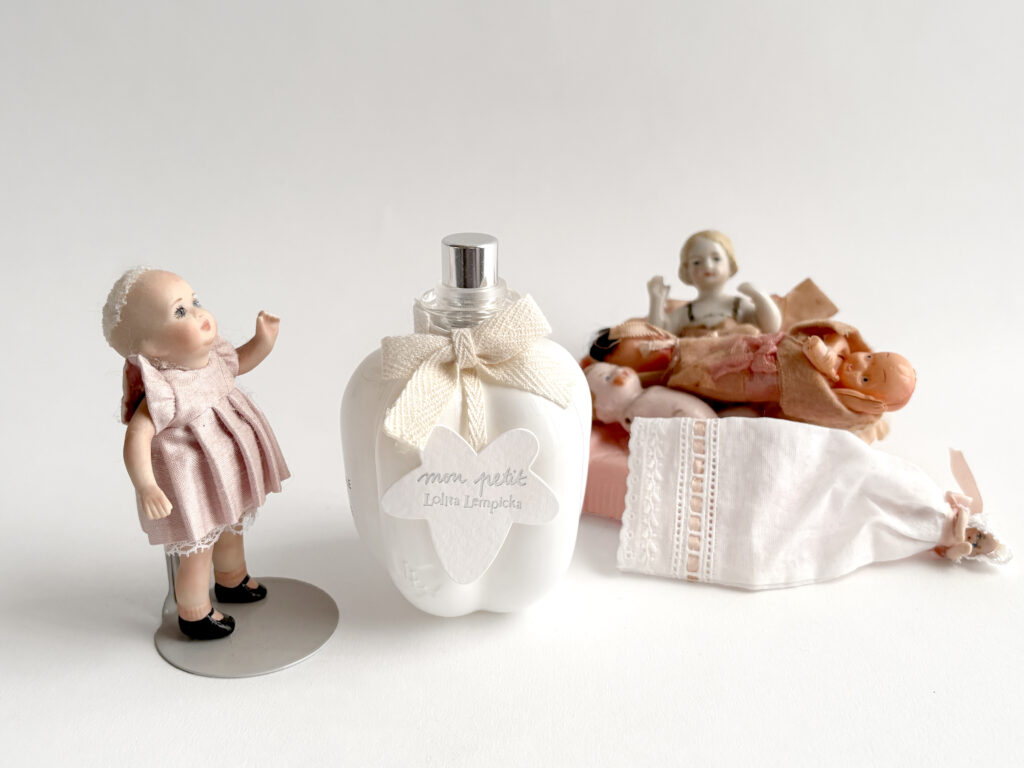
Photograph of personal collection by the author, 2026. Courtesy of studio of Matt Morris.
Marshmallow is one of the notes listed in Mon Petit, and the chunky opaque white bottle imitates that confection. There are few things I enjoy preparing more in my kitchen than marshmallow; I frequently tint them with pale pastel hues and flavor them with vanilla, almond, cherry, or even absinthe, violet, or scotch. The Lempicka marshmallow is limpid and pliant, articulated with woozy saccharine designs that give way to elegant, herbaceous striations in the blend. Given the confectionery overture, I am so surprised by how much, at least on my skin, it reminds me of Dove Grey, one of Alia Raza’s earliest blends at Régime des Fleurs and one of the high standards for my love in perfumery. I find bouquets of dried flowers at the heart of both scents, with matching embellishments of glistening dewiness. Mon Petit’s sweetness is astonishingly delicate; I snuffle out the freesia and an anise accord that figures in some of Lolita Lempicka’s best known perfumes. Along with marshmallow, a dry roasted almond with glassy candy shell also rolls about the graceful interior architecture of Mon Petit. Nose Maïa Lernout has received acclaim for her bright, light impressionism for other brands like Kenzo, Elie Saab, and Nina Rocco.
In some ways, Lempicka’s Mon Petit is the crux of this essay. Quite simply, I wear it, and I’m baby. By that, I mean that if I really pause to experience this perfume emanating from my pulse points, I exhale deeply. I let my guard down. I feel tears like diamonds like opals like pearls dotting my eyelashes, running across my cheeks. In its cloud, I can lower my defenses and admit that I can’t do this on my own. I’m so far from self-sufficient; there are so many times when I haven’t the foggiest idea what I’m doing. Mon Petit is a reminder to soften and to trust how my instincts register pleasure and gratification.
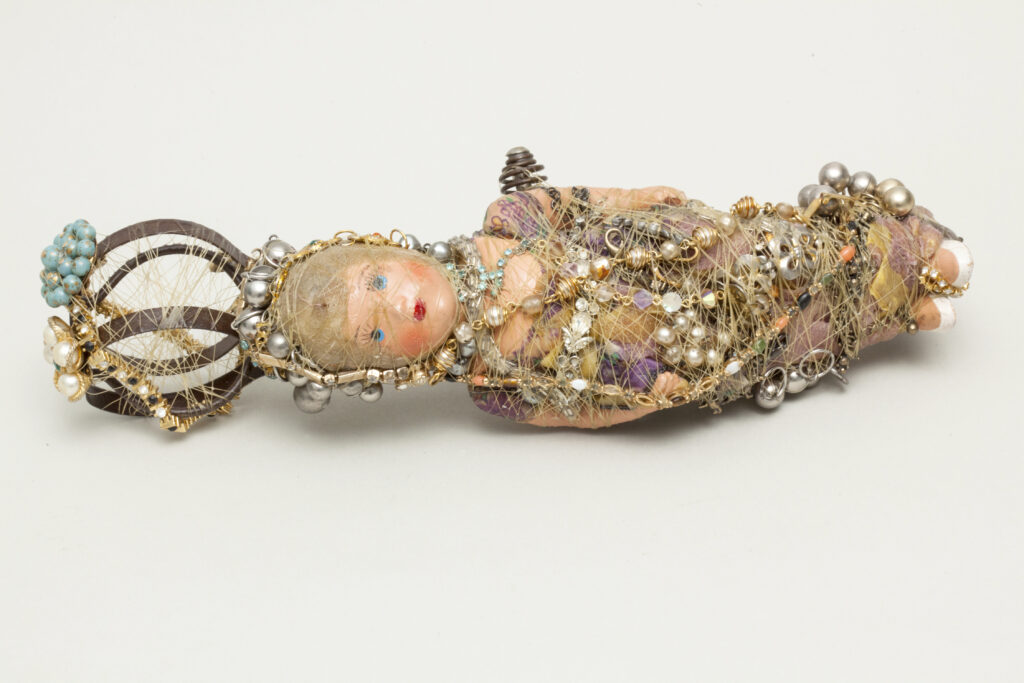
Nancy Youdelman. Wrapped Doll with Eggbeater, 2015
Mixed media sculpture
3.5 x 11.5 x 4.5 inches
private collection
photograph by Michael Karibian
© 2026 Nancy Youdelman
Maybe to say I’m baby is to acknowledge that I am a composite of all my needs—those that were met and those that never have been—a tumble through anticipation, disappointment, absences and reappearances, solace and scar tissue.
Being baby really just means signaling to the necessary care with which the interdependencies by which our lives, relationships, and biomes are organized—we don’t survive without some amount of conscious care for the other. If more people would admit the things they’re scared of, the anxiety that their needs won’t be met, that they won’t be provided for, what deeper work could we all do together? So much violence, stigma, and debate at the level of the sociopolitical are predicated on needs, whether or not they are met and by whom, allocation-and-distributions of assets, and civil unrest stoked by lack. Instead of accepting narratives that someone else benefits only at our deprivation, a fight over resources, and a whole hell of a lot of pressure to appear fine, successful, on the sending side of FOMO rather than receiving, Mon Petit smells like love alongside wishes not yet fulfilled, want in excess, restless dreams, and an enveloping hug—a ‘being held’ that I for one need way more than I usually want you to see that I do.
While some of these ‘babies’ were already in my personal collection, I wondered what popular recommendations were out there for perfumes-for-babies consumers. Quite a few sources led me to a little ‘eau de soin parfumée’ called Musti. It’s made by a French company called Mustela and retails in the US for around twenty bucks. Musti has this indelible earth tone in its gentle haze; so many things I smelled while researching this writing sends the wearer off into the clouds, and by comparison Musti is like a wren’s dust bath. Ultra sheer, sand turning into glass, this is a beachy bubble wand and also something infinitely more erudite. I can’t imagine an actual infant smelling like this, though blogging mothers on the Internet corroborate how popular it seems to be for exactly that application. Musti is clean clay: when I was growing up, one of my aunts detailed cars as a hobby (or side hustle?), and she introduced me to these clay bars that could draw embedded contaminates out of the surface finishes on vehicles. The clay, wash, and chamois toweling that follows are all carried in the light-wearing Musti.
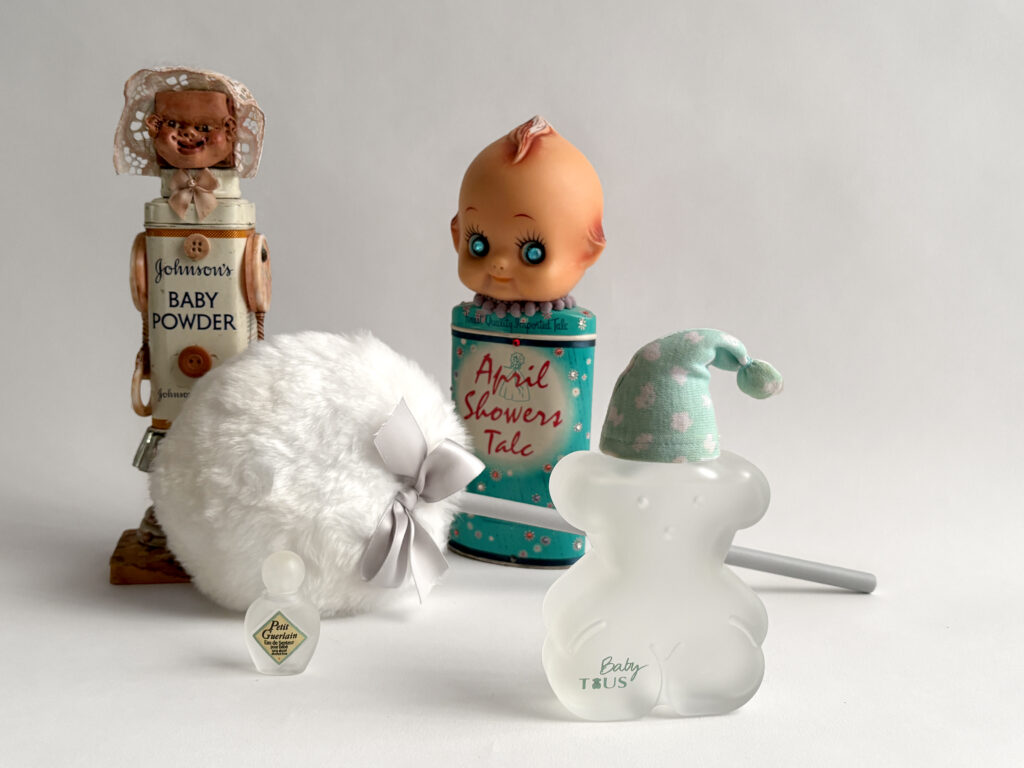
Photograph of personal collection by the author, 2026. Courtesy of studio of Matt Morris.
Petit Guerlain was a 1994 invention of Jean-Paul Guerlain. I have a vintage splash, so some notes may have shifted in the years intervening, but it is a pervasively soft situation that focuses on mimosa and hay-like coumarin/tonka refrains. A nimble and not-sweet lavender brings take-your-medicine gravitas to one edge of the composition, while facets of bee pollen and dark honey stud some of the floralcy at the heart of the fragrance. Its delicacy certainly follows on widely accepted smells for babies, but transposed into adult wearing, clean blossoms compliment peppery, weedy freshness. The dry, warm, almost-nectar of its base notes provide depth and volume to the golden fluff harvested off the top of, say, Apres l’Ondee or some other classic springtime profile from Guerlain’s archive.
The frosted glass teddy bear bottle and cloth night-cap-cap Tous’ Baby from 2007 give classic Avon novelty bottles, and its contents are scrubbed and abstractly astringent, with pronounced neroli-petitgrain profiles. Not listed, but I smell broom, even a bit of the minty side of mimosa. If a grassy marmalade was put through a spin cycle on the washer, it would turn into the Tous teddy bear Baby.
Michel Girard and Shyamala Maisondieu worked together on this one, but glancing through their respective portfolios, I noticed Girard also blended Baby Touch for Burberry in 2002, which I’ve not smelled, and neither have I encountered a 2015 fragrance he composed called Innoscent for Clash, but I mention them here because they perhaps demonstrate a sustained interest in a theme beyond the work on the Tous Baby. Meanwhile Shyamala Maisondieu has been attached to many different well known projects. She’s responsible for love-it-or-hate-it icon Pink Sugar, 2004, from Aqualina, as well as contributing to the group effort that has produced Lancôme’s Idôle and many of its flankers. I especially enjoy her 2015 perfume Palo Santo for Carner Barcelona—oddly, it doesn’t smell much like palo santo, but instead evokes the most comforting sweetened porridge or warm cereal.
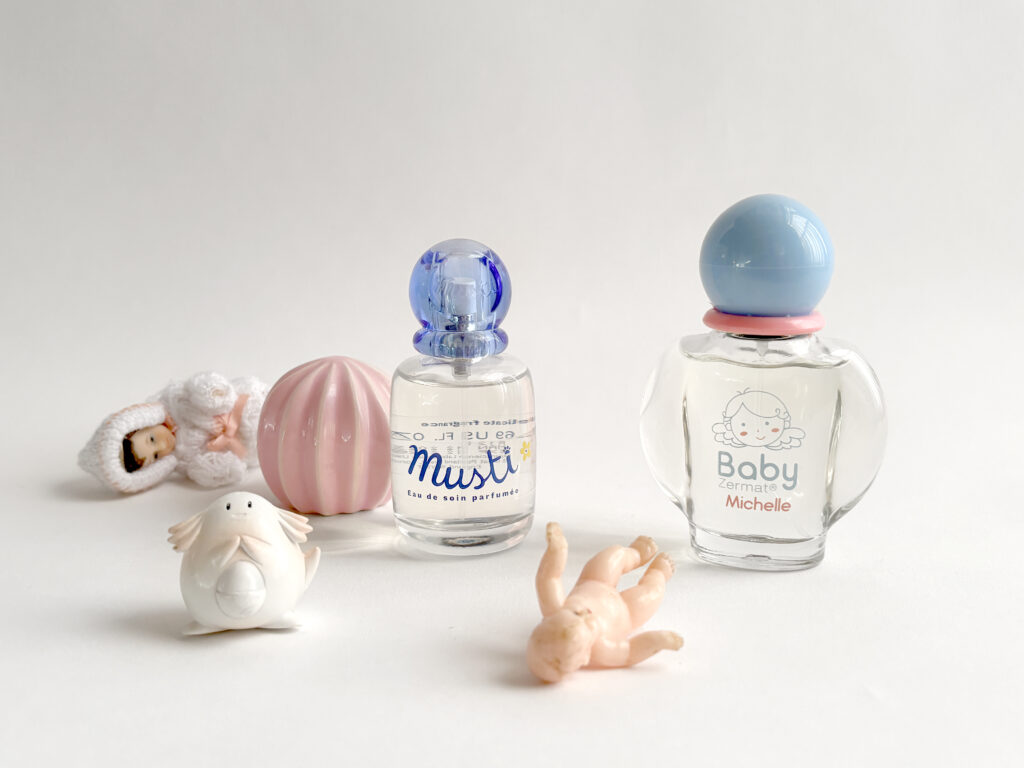
Photograph of personal collection by the author, 2026. Courtesy of studio of Matt Morris.
I found Baby Michelle by Zermat at a flea market where none of the vendors spoke English, but everyone was very gracious. It’s housed in a fun powder-blue-and-bubblegum-pink plastic bauble, like if Ettore Sottsass designed something for Sanrio or Tamagotchi. Baby Michelle is a spa day for those ‘ablution baby’ moments. It’s bracing, clean, bubbly. Nuances of dryer sheets, bathtubs, Aqua Net, and springtime air fresheners fizz and pop in an upright crémant mousse. Baby Michelle is more extroverted than most of these others: five-hour-energy in a pink plastic sippy cup. Of everything surveyed here, it’s maybe the one I occasionally think wavers between fragrance and deodorizer: its cheerful assertiveness would probably mask low frequency stinks in, say, a nursery or perambulator or linen closet. This nods to the squeaky floral musks in classic Johnson’s baby powder, ruffled blossoms at their most innocent and well behaved.
If some of these scents yield unanticipated possibilities for wearers and how they might ‘baby,’ themselves, Gwen Stefani’s Harajuku Lovers line released Baby in 2008 to describe precisely the way a grown femme can perform baby with relish and intent. Firmenich nose Harry Framont—who it should be noted has signed nearly 150 perfumes and counting —electro-charged Baby’s formulation with peak performances of coy, girlish, indolent, and charismatic personality traits. A freesia note very similar to the one in Lempicka’s Mon Petit shows the blurred categories at play here, while substantial violet and heliotrope phases, twined through with rose, waves at some of the powdery cosmetic effects that can be traced back to Baby Soft and Heaven Sent. The musks smell very 2000s, all jet-set microchip confetti showering over Tokyo. Harajuku Lovers Baby is a cool customer who gets what she wants. If some of the softnesses elsewhere in this writing express tender need, even helplessness, this Baby doesn’t want any less, in fact probably wants and needs more, and will tell you as much.
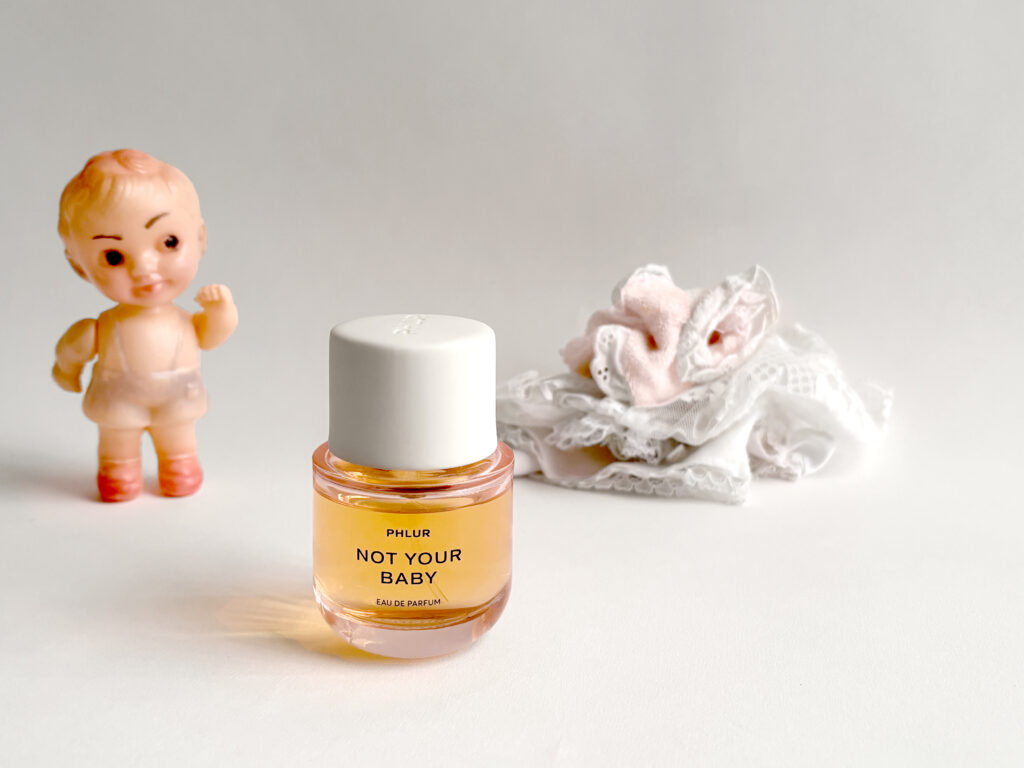
Photograph of personal collection by the author, 2026. Courtesy of studio of Matt Morris
It’s mean of me to invoke the 2010 Holygrapie from Comme des Garçons x Undercover, since it’s been apparently out of production for years and almost impossible to get ahold of. If it makes you feel better, my bottle’s nozzle is fucked up, and I usually have to get a partner or friend to help me dispense its dusty pink potion when I want it. Mean though it may be, I can’t seem to help invoking it—from a cursory glance through, its namechecked in at least four of my previously published texts. I have a problem. I’m unruly. My list for perfect powdery perfume is ungovernable.
And let’s face it: Holygrapie is a paragon of ‘fully grown up, self actualized baby,’ maybe the best there is at what it does—at once innocent and wizened, freshly floral combined with dusted history, many ages at once. Antoine Lie signed Holygrapie; he cushioned a central powdery iris with ingenious combinations of rhubarb, ginger, and a very floral black pepper. Ylang-ylang brings its sugar crystal effects, and cedar produces a dust that gets faintly earthy against all the poofy fluff of the scent. It undulates toward a styrax dry down—impeccable balsamic suede lolling like a ribbon train from the backside of Holygrapie’s doll effigy.
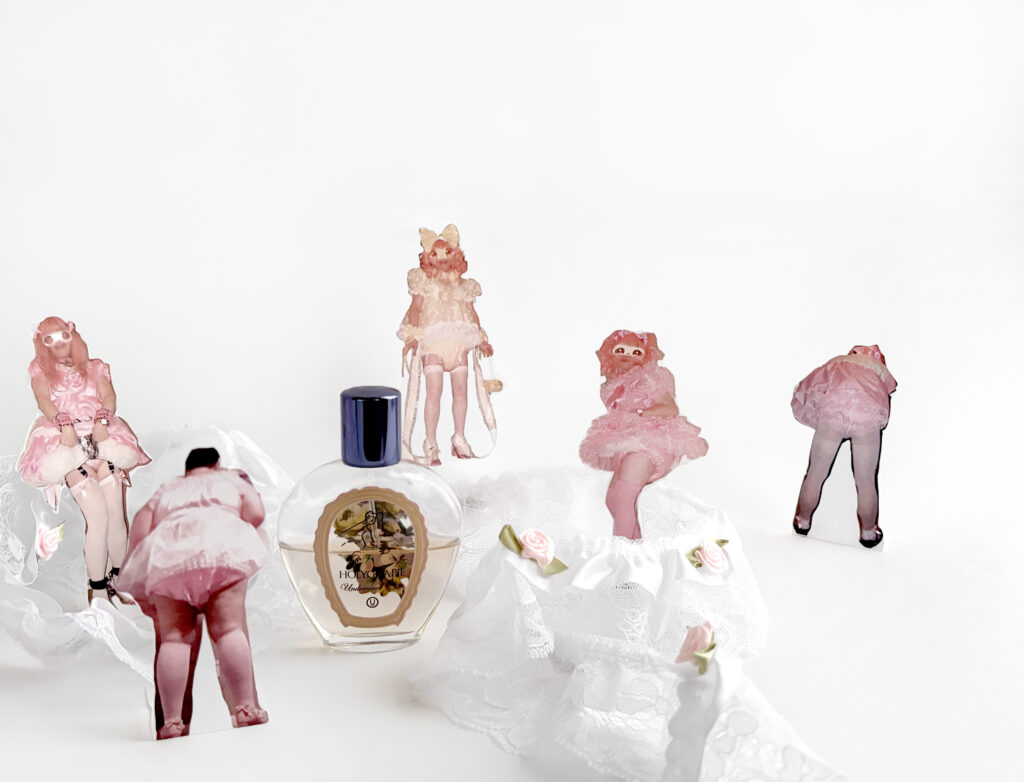
Photograph of personal collection by the author, 2026. Courtesy of studio of Matt Morris.
In amassing, wearing, noting, and considering a number of ‘baby’ perfumes, some with which I’ve been well familiar and others filling in zeitgeist gaps, I’ve found myself directed toward a crucial distinction in how we might understand the efficacy of fragrance: does perfume seek to cover up the bad, beautify abject realities, mask their stinkier bits, and impose a syrupy glaze of innocence onto parts of our lives that fail to live up to our own ideals? Or does the act itself interrupt a downward spiral, thereby changing how one acts, what one is doing—not only adding a new smell to a situation, but with it a new perspective, fundamentally improving whatever instance of the Real into which it’s been introduced?
The concept of perfuming an infant between its burps and diapers, coos and cries, doesn’t make sense to me, because I want to cherish disillusionment, seeing (and smelling) things for what they are, and finding love and gratitude thus. But one of the things I think perfume does best is expressing what has not yet been seen/known/understood/acknowledged. Perfume can be declarative, informative, confessional; just as importantly, it can help to remind us of who we are, what we care about, and parts of ourselves we want to emphasize.
I grew up being taught to never need anyone else for any reason, and to anticipate being disappointed by people not coming through on their commitments. I was taught to never look like I needed help (and I think it just never occurred to them to similarly stigmatize smelling like I needed help). So in grade school, if I was assigned to work on a group project, I tended to do it all by myself instead of getting uneven results from my classmates.
I sometimes think one of the overarching lessons of my life is learning enough vulnerability to admit that I have needs, along with embodying enough self love to believe those needs deserve to be met.
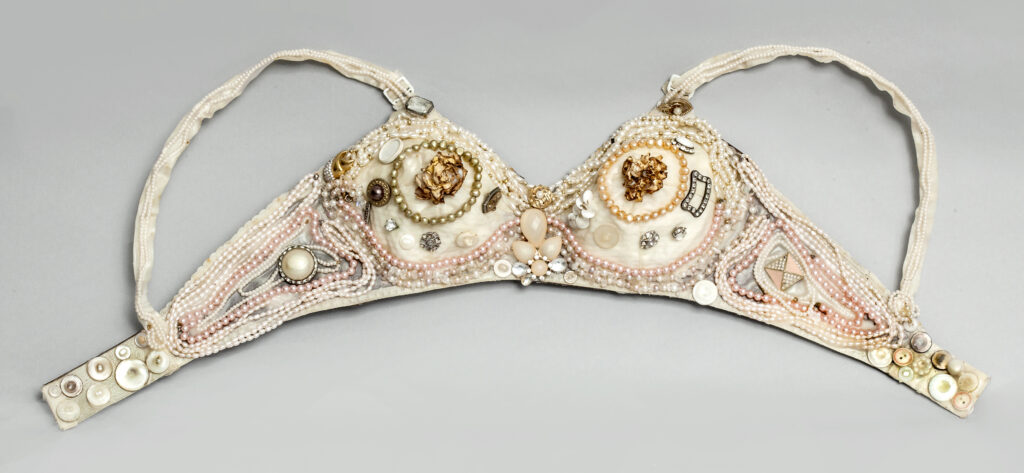
Nancy Youdelman. Frederick’s of Hollywood, 2019
mixed media 10 x 28 x 3 inches
photograph by Michael Karibian
© 2026 Nancy Youdelman
Courtesy of ADZ Gallery, Lisbon, Portugal
I wasn’t sure what I’d discover in smelling my way through baby perfumes. What I believe they have in common as a hybrid genre of perfumes-for-babies and perfumes-for-when-I’m-baby is that they are tacit instructions to handle with care, requests for situations to soften—everyone calms down, lower voices, bigger breaths inhaled and released. They are signals to those generous of spirit to offer what support they can. Most of all, baby perfumes are reminders that even as we age and mature, we never stop being all the versions of ourselves that we’ve been, including times when we’ve been more evidently helpless.
I think I’ve been reaching for these perfumes and others like them when I need to express, ‘I’m baby.’ And that is never trying to mask difficulties or ignore the unseemly parts of trying to survive living, but rather opting to hold myself and others with whom I interact in an atmosphere of care.
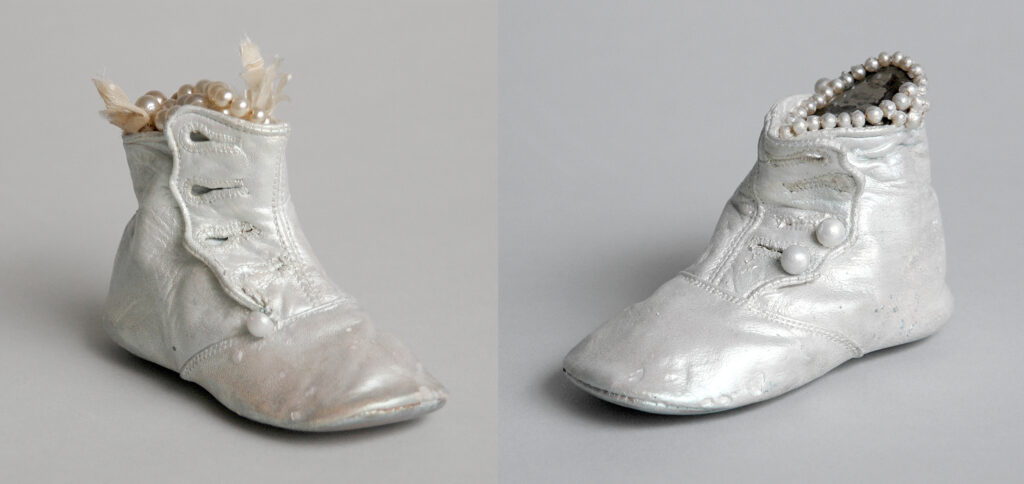
Nancy Youdelman. Tendering Offering (left) and Baby Pearl (right), 2005
Mixed media sculptures
each 3.5 x 2 x 4.5 inches
private collections
photograph by Michael Karibian
© 2026 Nancy Youdelman
Included in this essay are documentation of a series of artworks by the artist Nancy Youdelman. Youdelman is a powerhouse maker and thinker who has, since the early 1970s, produced inquisitive and incisive excesses in the forms of assemblage sculptures, installations, performances, and more. She exemplifies the ways that the women’s liberation project and successive waves of feminism examine the trappings of gender, family, beauty, mortality, and other constitutive forces that produce conditions of living for women everywhere (and every-when). Youdelman’s sensitivity to material as a record of memory, history, and fantasy propels her transfiguration of garments, trinkets, and domestic tools into talismanic explorations of desire and longing. Babies, children, and adult women across stages of life are evoked as specters and residue in her assemblages, whose surfaces convulse with senses of accreted ornament and entropic melancholy. Her work is as witty as it is mordant, edging beauty standards and fashion histories toward unseemly and unmanageable psychological and material excess.
Put plainly: my ability to form questions about the sensual experiences and rhetorical claims of these perfumes demarcated by conceptions of infancy, dependency, innocence, and newborn experience of the world at large are entirely predicated on the inquiries that continue to be posed by Nancy Youdelman and other women and femme artists of her generation. Youdelman participated in the storied Feminist Art Program at CalArts Valencia, and was included in the watershed immersive exhibition Womanhouse in 1972. Much of her work resonates with the progressive cultural movements of California, where she taught at Fresno’s California State University and where she continues to live and work.
It’s with immense gratitude that we were able to conspire to place these images of her work in dialogue with this text.
For more information about Nancy Youdelman’s work, please visit:
https://www.nancyyoudelman.com/
https://adz.gallery/artist/nancy-youdelman/
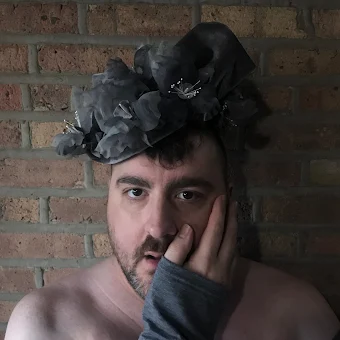
Matt Morris is a dedicated polymath who has exhibited extensively throughout the United States and Europe, and writes prolifically about art, perfume, fashion, and culture. His writing has appeared in such publications as Femme Art Review, Viscose Journal, Fragrantica, artforum.com, Flash Art, and X—TRA, as well as numerous artist monographs and the Routledge anthology Olfactory Art and the Political in an Age of Resistance. He holds a BFA from the Art Academy of Cincinnati and an MFA from Northwestern University. Matt is an Adjunct Associate Professor at the School of the Art Institute of Chicago. When he’s not teaching, traveling, or making art, Matt is reading, napping with two grey cats named Orlando and The Waves, cooking, and nerding out about film, comics, and perfumes that smell like lipstick.