On the perfume of Sofia Coppola’s The Virgin Suicides.
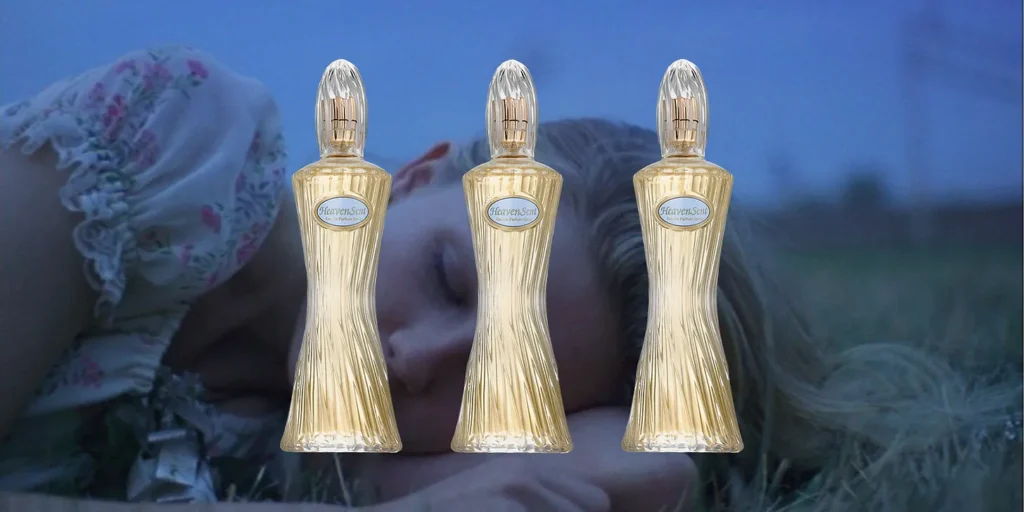
Do you ever spray the bathroom with Febreze to cover up the horrifying scent you left behind? In Sofia Coppola’s 1999 film The Virgin Suicides, Cecilia Lisbon uses Dana’s Heaven Sent Eau de Parfum as an air freshener to mask the fact that her life is a burning heap of garbage. If you’ve ever been a 13-year-old girl, you know that your beauty products and knick-knacks become an extension of your physical body, a tangible safety net to cradle your fall into pre-pubescent despair. I recently got my hands on the 2001 version of Heaven Sent from FragranceNet—however, in the film, the bottle that Cecilia (Hanna R. Hall) has is a vintage bottle by Helena Rubinstein, originally launched in 1941. Both the modern and original bottles look almost identical, highlighting Coppola’s intense eye for authenticity. (This was confirmed by World Wide Aura, an awesome digital archive of beauty products in TV and film.) On Cecilia’s vanity, designed by Coppola and production designer Jasna Stefanovich, beside Heaven Sent lies a bottle of Jovan Musk cologne from 1972, among other delicate girly accessories—Cecilia has good taste.
Sociologist Erving Goffman’s dramaturgical theory of impression management provides a useful lens to peer at Cecilia through. In his 1956 book The Presentation of Self in Everyday Life, Goffman theorizes that we have a “backstage” and “frontstage” self, and we perform them differently according to each circumstance we find ourselves in. Putting the ubiquity of curating a persona nowadays (like with social media) aside, real-life intimate social micro-interactions are where observing impression management can be useful. This goes much deeper than simply being “real” or “fake.” It is often more instinctual, dare I say, primitive—we want our tribe to accept us so we can hunt together and not die of starvation. Humans have learned we can attempt to manage how other people perceive us, and in the modern era, consumerism makes it incredibly easy to control that external perception. You can order a new persona on Amazon and have it at your doorstep in 24 hours. In the film, Cecilia uses Heaven Sent as a prop in the tragedy that is her life. Maybe she purchased it herself; maybe it was a gift from her evil mother (Kathleen Turner)—we don’t know. Regardless, it’s really quite meta: Coppola uses the perfume as a prop to tell the story in her movie, while Cecilia uses it as an instrument to embellish her short fictional life. People use fragrance as camouflage all the time—like most commodities, this is what makes buying things fun (for example, I wear Angel by Mugler at times when I feel like a goblin).
If you take an introductory acting class, the teacher will most likely ask you Stanislavskian questions about your character, such as: “Who are you?” “Where were you born?” “What does this character do in their spare time?” Every speck of detail is paramount to building a robust narrative. Similarly, knowing what a movie character smells like, or what personal products they use can enhance the story’s reality and texture through olfactory exploration. The Lisbon sisters’ accouterments strewn about their home, art on their walls, and more stuffed animals than books on their shelves is an unforgettable vignette for most tweenage females—as biological and psychological emotional turmoil ensues, like the shock of reconciling with not being girl nor woman, but rather an excruciating third thing, the only way to survive it is by retreating to your bedroom dwelling. The bedroom and its contents are the safety mats placed for your first gym class cartwheel; if it’s not just right, the fall will hurt.
Hanna R. Hall has the perfect face for melancholy. She effortlessly evokes the boredom, dissatisfaction, and indifference that is mandatory to feel like a Lisbon sister. Her permanent half-smile suggests she spiritually passed away years ago, and her physical body is staying awhile just to mess around—but she is looking forward to leaving this dimension entirely. The peak of Cecilia’s palpable discomfort can be pinpointed to the birthday party scene, when she has a front-seat view of the forced theatrics her mother and father (James Woods) orchestrate for her party. The gathering, prescribed by a therapist who thinks Cecilia just needs to socialize with males her age, is quite literally the nail in her coffin. After the teen boy with Down syndrome is brought into the party and cruelly paraded around like a circus clown by the other boys and girls, Cecilia excuses herself to her bedroom and attempts suicide once again, finally with success. In that brief scene, her empty glare sends a very clear message—this life is a joke. She longed to be heard by her mother, for her to express genuine interest in her life—endangered animal species, for example—but yet her mother is incapable of that connection. She is gone, leaving a cloud of honeyed flowers dipped in powder behind. Each sublime element in Heaven Sent plays a crucial role in this tragedy, from the exposition to the denouement. Let’s dive into a breakdown of the composition of this fragrance, as listed on the box:
TOP
Apple blossom, bergamot, mandarin, lily of the valley (muguet)
MIDDLE
Iris (orris), jasmine, heliotrope, rose
BASE
Amber, musk, oakmoss, patchouli, sandalwood
It’s violet petals crushed into a powdery elixir dripping with desire—the desire to be loved, accepted by parents and peers, or just to get through grade school in the suburbs before your excruciating Catholic home life drives you to kill yourself. It follows the precise formula for a chypre, down to the subtle oakmoss bottom note. As it dries down, it is pure baby powder thanks to the orris and heliotrope blend, bearing striking similarities to Heliotrope Milkbath by Universal Flowering. Add a splash of almond milk, and it will be difficult to make out which is which. This baby powder is so saccharine it borders on gourmand—and has me wishing for a Pixy Stick full of it.
Heaven Sent serves as a tool to mask Cecilia’s angst as the youngest sibling and is a piece of the desperate bridge extended to her mother in longing for emotional presence. Heaven Sent is pure powdery innocence, made with the tears of angels, a protection spell against all evil—which ultimately contrasts with her miserable life. The ornate bottle is a direct pathway from the Earth to the clouds, a holy grail that ushers her toward mortality. There is something Rumpelstiltskineqsue to it; an imp-like deity surely weaved this perfume out of gold just for her. In all seriousness, please don’t make Cecilia your role model—get help if you need it. But do yourself a favor and buy a bottle—not only to honor the inner Lisbon sister in all of us but to reconcile with our desire for a scent both feminine and prurient.
Originally published on HALOSCOPE.ORG on December 21, 2024.